LINGBANG INTELLIGENCE · VISIONAGENT / PROJECT PRACTICE
Implementing Seven-Step Handwashing Compliance in a Pharmaceutical Cleanroom
Step recognition, per-step timing, and final compliance decisions—VisionAgent tracks all eight stages before cleanroom entry.
KEY TAKEAWAYS
- Eight stages are verified. Seven hand-rubbing movements—palms, backs, between fingers, knuckles, thumbs, fingertips, and wrists—plus final hand drying.
- Each result is visible. The live view labels the current movement while the step cards show elapsed time and either “Time Met” or “Time Insufficient.”
- A final decision is produced. Jewelry triggers a failed result; completing all eight stages produces a pass.
- The tensor flow is software-defined. Five operators are connected on the tensor-flow canvas, while an
S0–S8state graph controls progression. - The requirement becomes an engineering definition. The SOP is decomposed into movements, sequence, status, exceptions, and outputs, then implemented in software.
At the cleanroom entrance, the system verifies whether each worker completes the prescribed handwashing routine. The page turns one continuous action sequence into eight visible step cards, recognizes the current movement, records each step, and returns a final decision.
01/5PROJECT SCOPE
Verify Every Stage of the Standard Routine
This project covers the standard handwashing process before cleanroom entry. The system checks seven hand-rubbing movements and includes final hand drying as the eighth stage.
- 01 PalmsPalm-to-palm rubbing
- 02 BacksRub the backs of both hands
- 03 FingersRub between the fingers
- 04 KnucklesRub bent finger joints
- 05 ThumbsRotate around each thumb
- 06 FingertipsRub fingertips in the palm
- 07 WristsRub both wrists
- 08 DryingComplete hand drying
The page presents three kinds of information at the same time: the current movement on the live image, per-step status on the eight cards, and the final process outcome at the top of the page.
02/5DECISION LOGIC
Movement, Timing, and Exceptions Update Together
During operation, the hand contour and movement label update with the live image. The eight cards represent the eight handwashing stages: completed stages turn green, stages with insufficient time turn amber, and stages not yet started remain inactive.
Jewelry detection runs independently from the eight stages. In this case, the recognition view first identifies a jewelry error. The page then displays a failed handwashing result and marks all eight cards red.
After the jewelry is removed, the system continues checking the remaining movements.
After hand drying is completed, the eighth card updates and the page displays “Handwashing passed—all steps completed.”
03/5CASE RESULTS
Three Key Screens from the Case
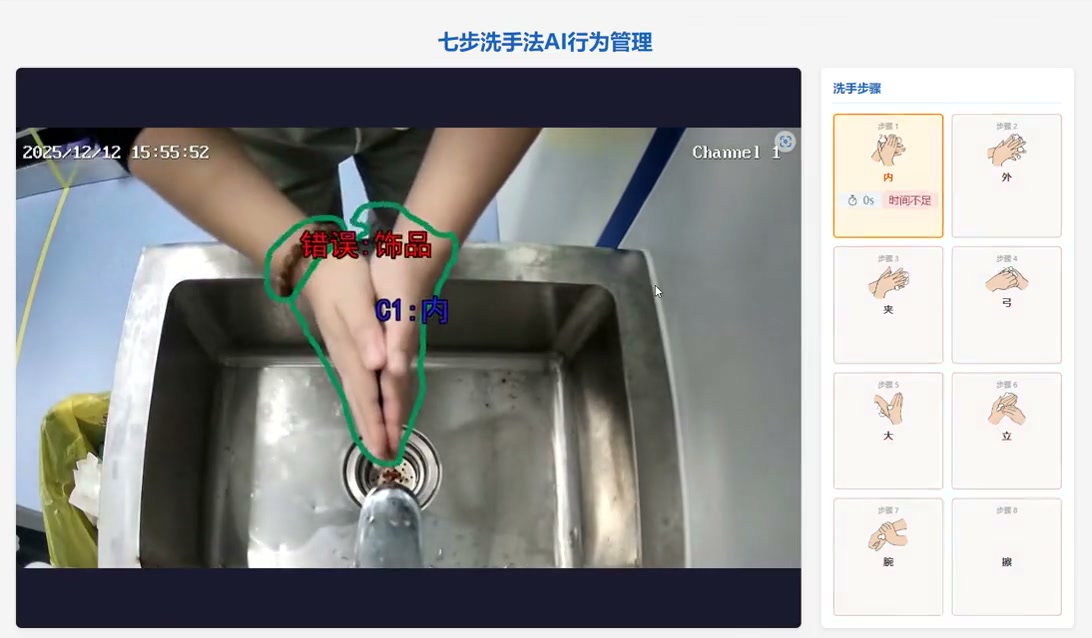
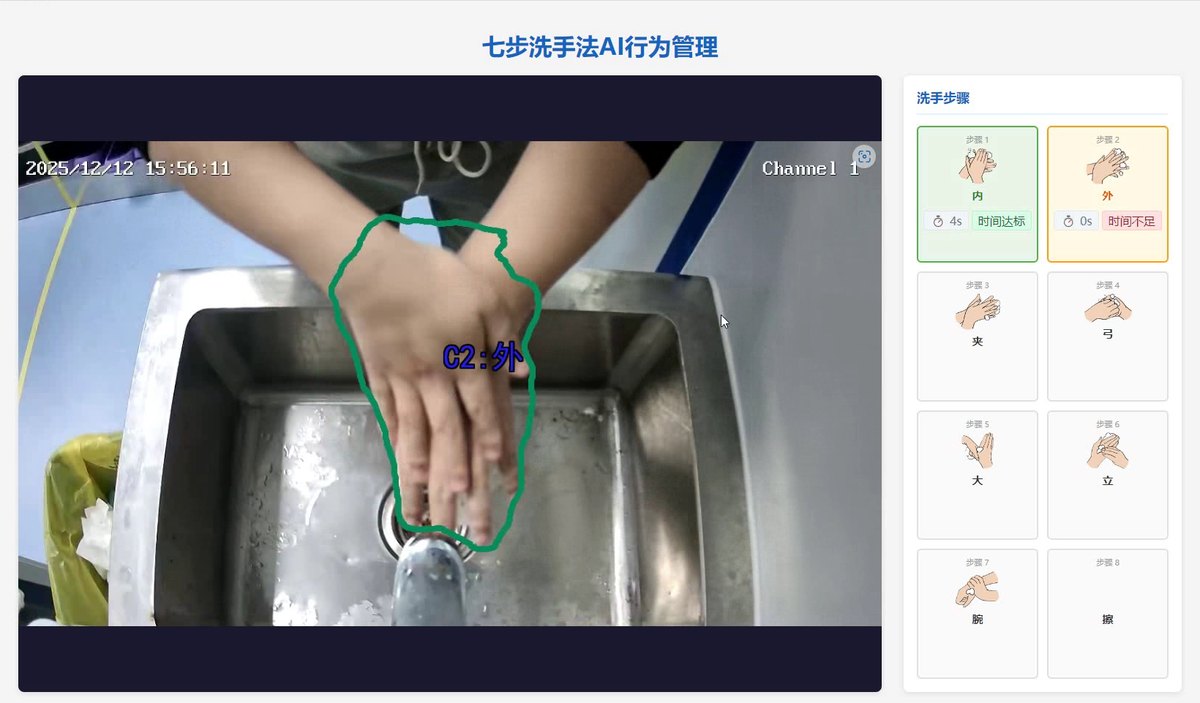
C2: Backs. Step 1 shows 4 seconds and “Time Met,” while Step 2 shows 0 seconds and “Time Insufficient.”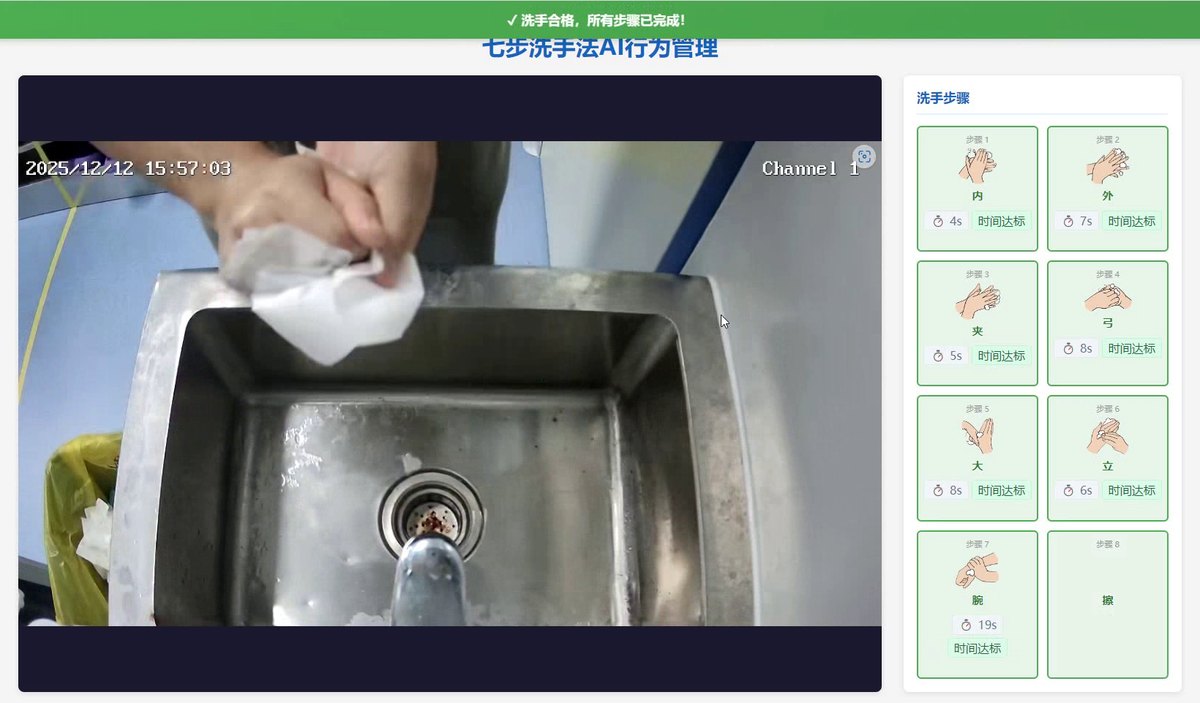
04/5EDGE VISION AGENT
Orchestrate Operators on the Tensor-Flow Canvas
VisionAgent software runs at the edge and handles tensor-flow configuration, execution, visualization, and result output.
In this case, camera input, model loading, tensor-flow orchestration, real-time recognition, visual overlays, and runtime status are managed in one software environment.
01Integrated Training and Inference at the Edge
Integrated training and inference brings sample annotation, model training, model loading, and real-time inference into the same edge system.
During commissioning, teams can update the model and tensor flow on site. During operation, the same device processes live images and generates results.
Configuration starts with three tasks: connect the camera, select the model, and create a tensor flow. Nodes and connections are saved on the tensor-flow canvas, so movements and decision relationships can be adjusted directly when requirements change.
02Five Operators Form the Handwashing Tensor Flow
This case uses no-code drag-and-drop orchestration to configure the tensor flow. The required operators are selected from the operator library, placed on the canvas, and connected in data-flow order. The handwashing tensor flow contains five operators:
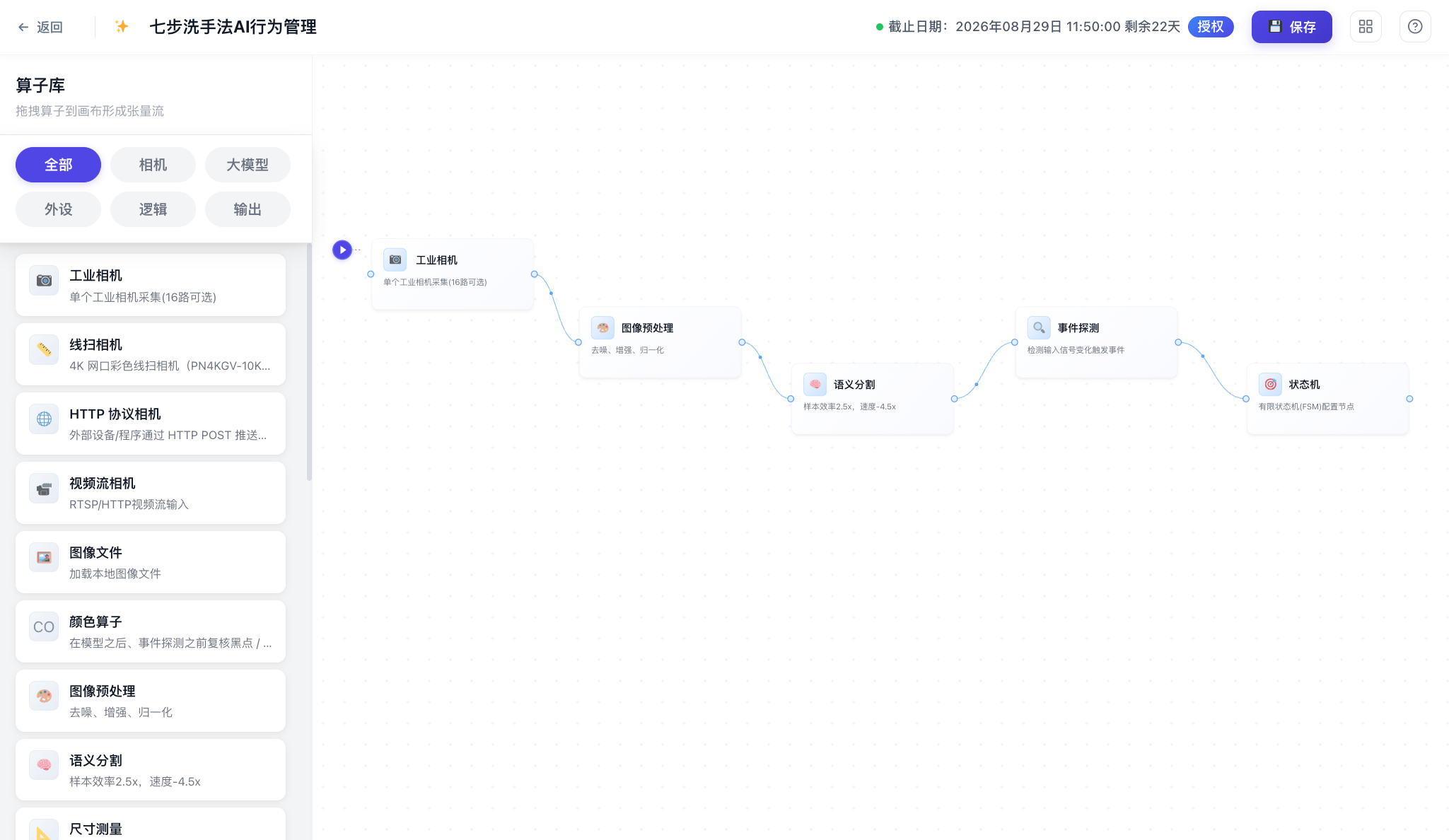
- Industrial Camera: Supplies a continuous live image from the handwashing station.
- Image Preprocessing: Prepares the camera image for the vision model.
- Semantic Segmentation: Recognizes the current movement and produces a hand contour and class label.
- Event Detection: Converts model results into event signals that the tensor flow can use.
- State Machine: Advances the handwashing sequence, maintains the current process state, and supplies the basis for the final decision.
Semantic segmentation determines the current movement. Event detection and the state machine then determine how far the process has progressed. Together, they connect frame-level recognition into a complete handwashing sequence.
03The State Graph Controls the Eight Stages
In the state editor, the SOP appears as nodes and connections. S0 starts timing, S1–S7 represent palms, backs, fingers, knuckles, thumbs, fingertips, and wrists, and S8 represents drying. Events E0–E7 connect adjacent stages.
The sequence can be reviewed and adjusted directly on the graph.
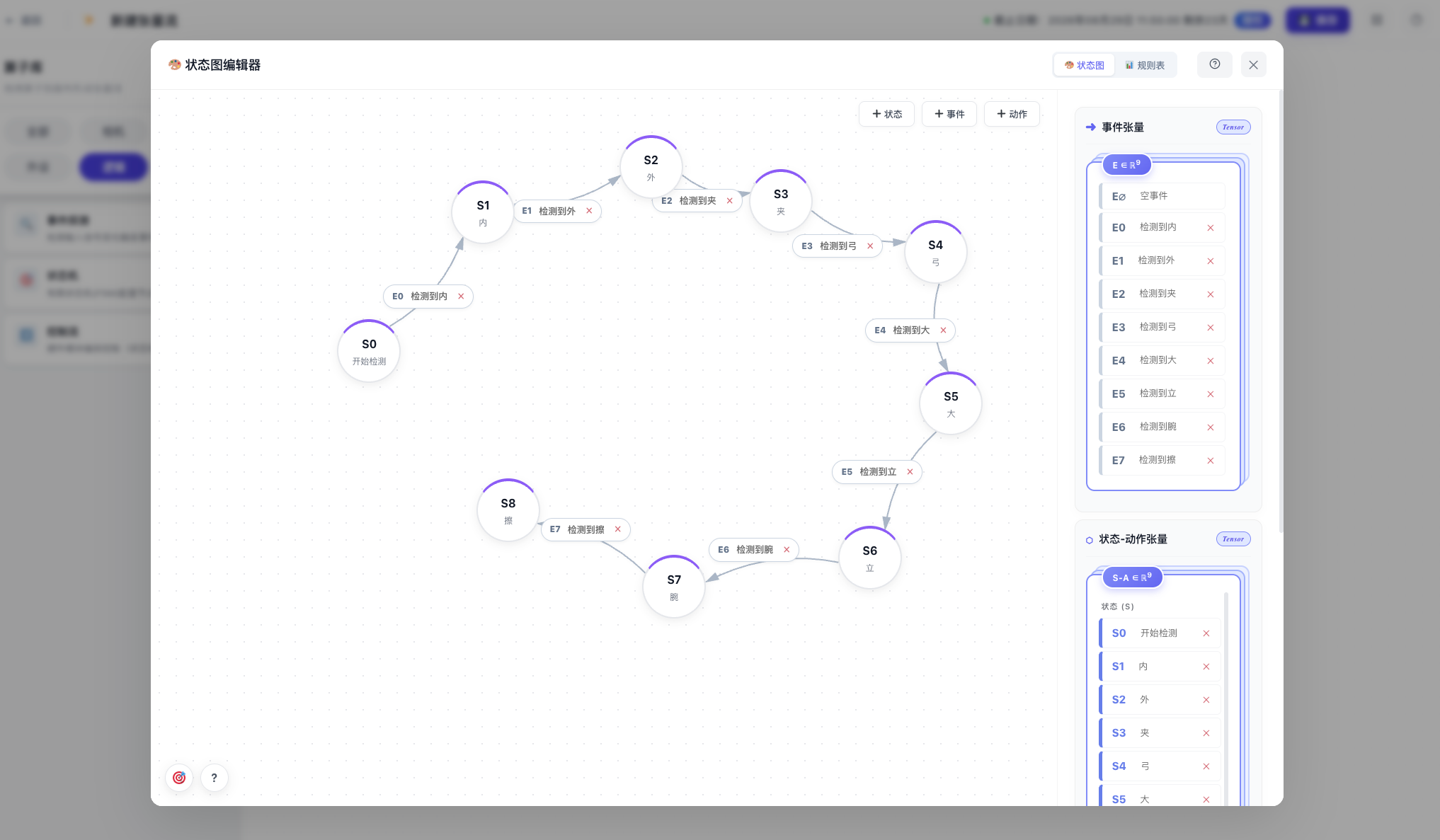
S0 is “Start Timing,” S1–S7 map to the seven rubbing movements, S8 maps to drying, and E0–E7 connect the stages.When an event arrives, the software updates the current state and refreshes the step cards. Jewelry appears as an independent exception on the runtime page and immediately produces a failed result.
The tensor-flow canvas connects acquisition, processing, recognition, and decision logic; the state graph controls the required order.
04Monitor, Display, and Output from One Interface
At runtime, the software overlays movement classes and hand contours on the live image. The step cards show timing and status, while the top banner displays the final process decision.
Teams can review camera, model, tensor-flow, and runtime information from the same interface.
VisionAgent also supports structured output through HTTP, including classes and contours.
When integration with MES or SCADA is required, result fields and delivery methods can be configured to match the site interface.
The implementation produces four visible outcomes: real-time movement recognition, verification of all eight stages, synchronized timing and status, and a clear final decision.
The standard handwashing routine therefore becomes a process record that can be checked and summarized.
05PROJECT LESSONS
Translate Customer Requirements into Executable Rules
My strongest lesson from this project is that customer requirements need a complete engineering translation before they can run in a live system. The customer asks workers to complete the seven-step handwashing routine before entering the cleanroom. The system still needs explicit definitions for which movements to recognize, how each stage is recorded, which conditions cause failure, and what result must be delivered.
In this project, the requirement was decomposed into three layers:
- Business requirement: Complete the standard handwashing routine before cleanroom entry and detect jewelry exceptions.
- Decision rules: Verify all eight stages, record step status, and generate a final decision.
- Software configuration: Build the tensor flow with five operators and define sequence progression through the
S0–S8state graph.
Once these layers are aligned, model results can enter the live operating process. Clearer requirements lead to more stable image acquisition, model training, tensor-flow configuration, and acceptance criteria.
LESSONDeployment Lives in the Details
My deepest lesson from this project is that the customer's requirement and the on-site system need a complete engineering translation.
“Complete the seven-step handwashing routine” states the goal. The system still needs to know which movements to recognize, how to record each stage, which conditions cause failure, and what result to output.
With those details confirmed, the system became a tool that operators were willing to use and whose results could withstand review.
Looking back on the project, four questions ran through the implementation: What does the system observe? When is a step complete? Which conditions cause immediate failure? How will the result be retained?
For cleanroom handwashing verification, site teams can provide station footage and the SOP so that recognition stages, decision rules, and system interfaces can be confirmed.
LINGBANG Intelligence · VisionAgent · Contact details are available through LINGBANG's official channels
We make every execution traceable and trustworthy. That is the value of technology this project taught me.
ZHOU
Ethan Zhou
VisionAgent Solutions & Delivery · LINGBANG Intelligence
Focused on the design and deployment of industrial VisionAgent solutions. His work covers feasibility assessment, on-site image acquisition and dataset preparation, and model training and tuning.
His work also includes no-code tensor-flow orchestration and integration with MES and SCADA systems.
He focuses on translating on-site SOPs into rules that machines can recognize, evaluate, and record. His articles document real project configurations, decision logic, and field results.