VisionAgent at Vision China 2026 Beijing — two days to go
Two days to go. Lingbang Intelligence will bring VisionAgent to Vision China 2026 (Beijing). The show’s theme is a new generation of machine vision driven by embodied intelligence and industrial foundation models. We will share the latest work on our inspection foundation model and visual agent. Visit Hall 4, booth A07 for a one-to-many, multi-task, multi-line approach.
Show details
- Event: Vision China 2026 (Beijing)
- Theme: next-generation machine vision driven by embodied intelligence and industrial foundation models
- Dates: 25–26 June 2026
- Venue: Beijing International Convention Center, Halls 4 & 5
- Lingbang booth: Hall 4 A07
Forum talk
Chairman’s talk: “VisionAgent: generalization and deployment in complex manufacturing,” 26 June, 13:55–14:20. One edge agent carries many cameras, stations and lines—train and infer in the same stack.
On the floor, vision is no longer just “take a photo and find a defect.” Many SKUs, small batches, frequent changeovers and parallel stations raise a more practical question: when products, defects, processes and lines keep changing, can inspection still deploy faster, copy cheaper, and run stably?
At this show Lingbang will show how an inspection foundation model moves from a one-off project to general productivity.
What to see on the stand
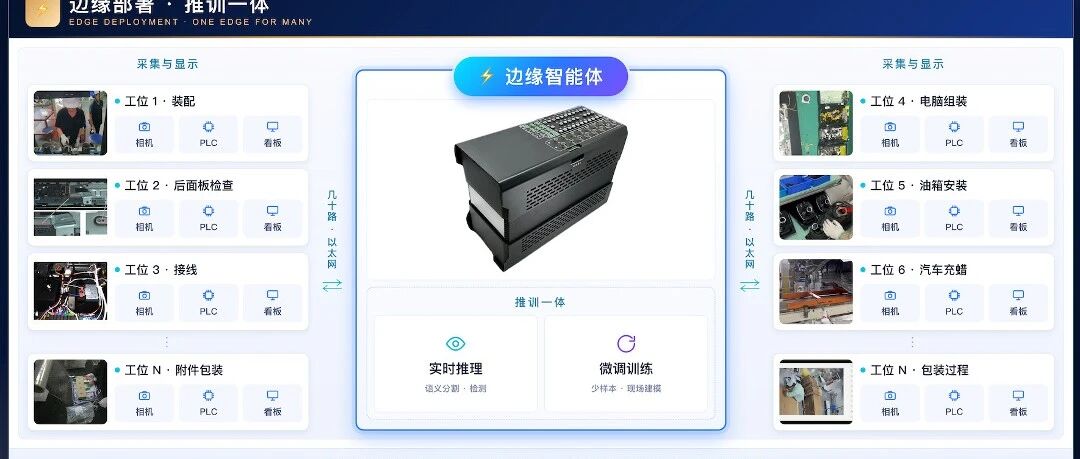
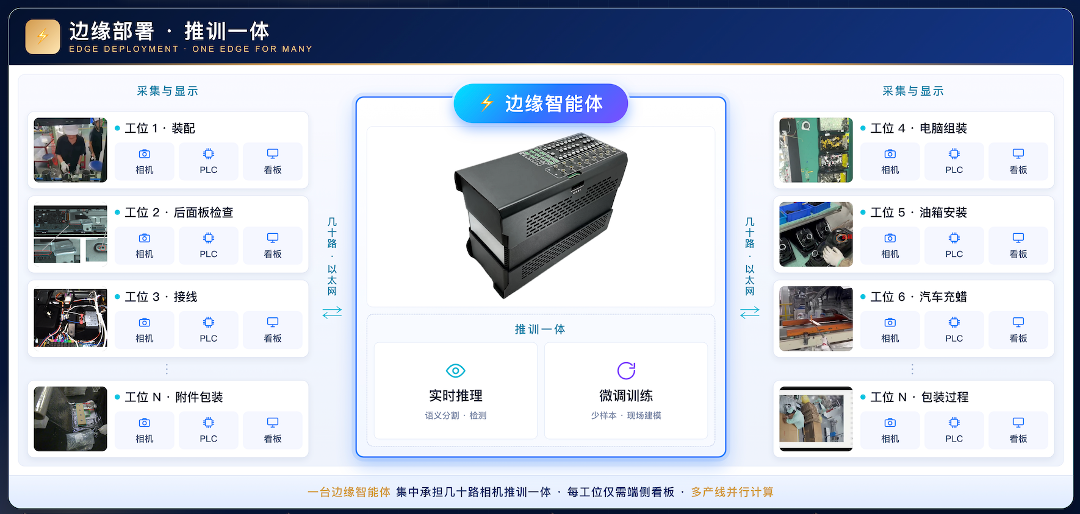
- One-to-many, at scale. One edge agent trains and infers for many cameras, instead of stacking an industrial PC at every station. In the demo case, one agent drives 16 lines and 80 4K cameras.
- Multi-task, multi-line. Assembly correctness, accessory packing, wiring checks and appearance defects can be orchestrated and managed on one platform.
- Few-shot go-live. With the inspection foundation model, 1–5 samples per class are enough to configure a new product or defect on site.
- Zero-code drag-and-drop. Cameras, the foundation model, logic, built-in PLC, peripherals, MES and outputs connect as industrial operators—configuration stays visual.
Why come in person
The hard part on a complex line is rarely whether one checkpoint can recognize an object. It is whether the whole system can keep adapting.
- Changing mix: many SKUs rotate on and off the line; a “one model per type” project takes too long.
- Changing defects: new faults keep appearing; small models miss them when samples are scarce.
- Changing form: from appearance defects to assembly correctness to motion-process monitoring, the object of inspection is getting harder.
- Changing lines: many stations, lines and cameras at once—hardware spend and later maintenance have to be recalculated.
VisionAgent: train-and-infer on the edge
VisionAgent sits on Lingbang’s inspection foundation model, trained on 100 million+ industrial images with 1.3 billion parameters. Defects, material appearance, product structure and process scenes become reusable capability.
With edge deployment and a train-and-infer stack, training, inference, orchestration and output happen on site—for real multi-line, multi-station, multi-task production.
Scenes on the floor
- Industrial defects: fabric, rolled steel, components, pouch batteries, rear-axle gears, brake pads, phone camera covers, and more.
- Assembly checks: missing screws, microwave wiring, glue on a mining-machine power supply, appliance cartons, appearance checkers.
- Process monitoring: packing, PC assembly, fuel-tank install, wax fill, accessory packing, onboard-document packing, medical-device packing.
Hall 4 A07, 25–26 June, Beijing. Come talk through how VisionAgent lands in complex manufacturing.